The Entrance Is the First Instruction
Event entrance design helps arriving guests choose the right route at a glance, using visible thresholds, clear sightlines and a few well-placed cues.
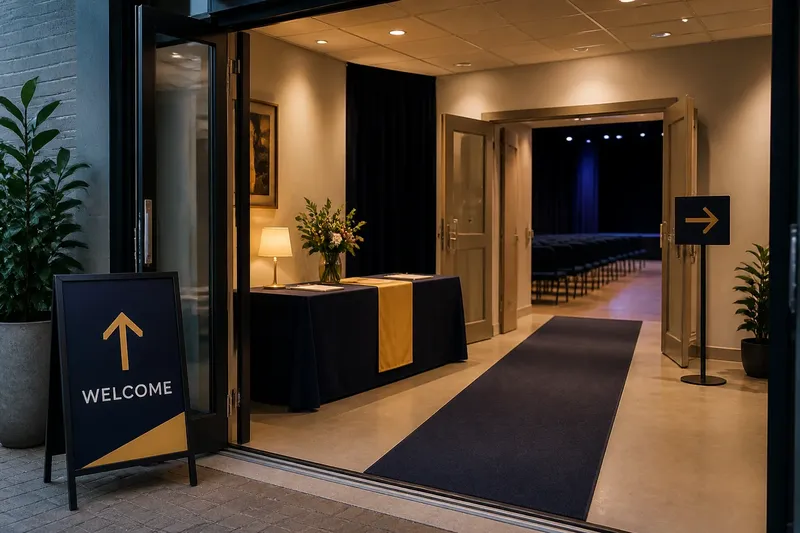
Event entrance design should tell arriving guests where to go before they reach a signboard. A visible threshold, an unobstructed view into the venue and a small number of deliberate cues can make the next move apparent without crowding the doorway with information.
That clarity takes more than a quick look at the floor plan. Build it into the venue walk-through during the week before the event, then check it again on the morning, when furniture, equipment and people can change what guests actually see.
One week out
Start at the place guests will approach from: the pavement, car park, foyer or shared building corridor. Stand at likely arrival points and trace the route from there to the first meaningful destination, such as registration, a coat area or the main room.
Notice what competes for attention. A reception desk, a closed door, a queue barrier or a bright display may pull people towards the wrong place, even if the intended route seems obvious on the plan. Mark the first point where a guest could hesitate.
Choose one primary entrance and make its purpose legible. This might mean opening a pair of doors, using a contrasting runner, or arranging a freestanding welcome board beside—not in front of—the route. Keep the threshold open enough for people to enter without stopping in the flow.
- Check which entrance guests can see from their approach.
- Identify the first decision point after the door.
- Look for furniture or displays that hide the destination.
- Decide where a queue can form without blocking the entrance.
- Choose one visual cue to distinguish the guest route.
Make a simple plan of the approach and mark each cue where it will be visible. A cue should answer one question at a time: “Is this the entrance?”, “Where do I check in?” or “Which way is the hall?”
Three days out
Walk the route at guest height, not only from a stage or production desk. A tall floral arrangement, a banner stand or the backs of people in a queue can obscure a view that looked clear when the room was empty.
Use visual hierarchy rather than adding more wording. Make the destination itself easy to recognise: keep the registration table in view, leave the main room’s doors open if appropriate, or use a distinct colour on a directional marker. Avoid placing several competing signs together.
Check that the route remains understandable for guests who cannot rely on small print or a distant display. Use readable type, strong contrast and arrows placed at the point where a choice occurs. A floor mark or a change in lighting can reinforce direction, but it should not be the only clue.
Say you are preparing a community hall with a side entrance, a registration table and a second door to the auditorium. Imagine the side entrance opens onto a corridor where guests can see both doors but cannot tell which is for the event. Move registration into sight of the entrance and place one arrow at the junction; the expected observable result is that guests can identify check-in before choosing the auditorium door.
Event morning
Rehearse the arrival route before the room fills. Ask a colleague unfamiliar with the set-up to enter from the public approach and say what they think each visible cue means. Watch where they pause, turn or ask for help; those moments show where the environment is giving mixed instructions.
Then inspect the route with the actual equipment in place. Confirm that cable covers, lighting stands, queue barriers and storage do not narrow the entrance or hide the next destination. Keep the welcome point close enough to be found, but not so close that guests stopping there block those behind them.
Assign a greeter to the first decision point rather than stationing every staff member at the desk. A person can quietly direct guests who need help while the entrance itself remains easy to read. Brief the greeter on the intended route and any accessible alternative.
During arrivals
Watch the entrance from just outside the main flow. If guests repeatedly stop at one spot, treat that as a design signal rather than a reason to add another large display immediately. A small repositioning of a stand, barrier or table may restore the sightline.
Keep the route consistent as doors open and queues grow. Do not move the registration point or redirect guests without updating the cue at the approach. If a change is unavoidable, put a staff member at the old decision point and make the new direction visible before guests reach it.
Use spoken help as a supplement, not as the main navigation system. Guests arriving at different times should still be able to work out where to go when no staff member is free to answer.
Event entrance design questions?
How many signs should an entrance have?
Use only the signs needed to answer distinct questions at distinct decision points. If several signs repeat directions or compete for attention, remove or relocate the least useful one.
Where should the welcome desk go?
Place it where guests can see it shortly after entering, without blocking the doorway or the onward route. Leave enough room for a short queue to form beside the main flow.
What makes a sightline clear?
A guest should be able to see the next destination or the cue that directs them towards it from the point where they must choose. Check from standing and seated perspectives where those are relevant to the event.
Can lighting help people find the entrance?
Lighting can draw attention to a doorway or route, especially where the venue has several similar openings. Keep the lighting cue consistent with the signs and visible path, and coordinate any changes with the venue or production team.
After the doors close
Before dismantling the welcome area, note where staff gave repeated directions and which cues guests seemed to notice. Record the location and the specific confusion, such as a hidden registration table or an ambiguous doorway, rather than writing only that the entrance felt unclear.
Use those observations to adjust the next room plan. Event entrance design works best when each cue sits at the moment a guest needs it: one clear invitation at the threshold, a visible destination beyond it and help available where the route asks for a decision.